

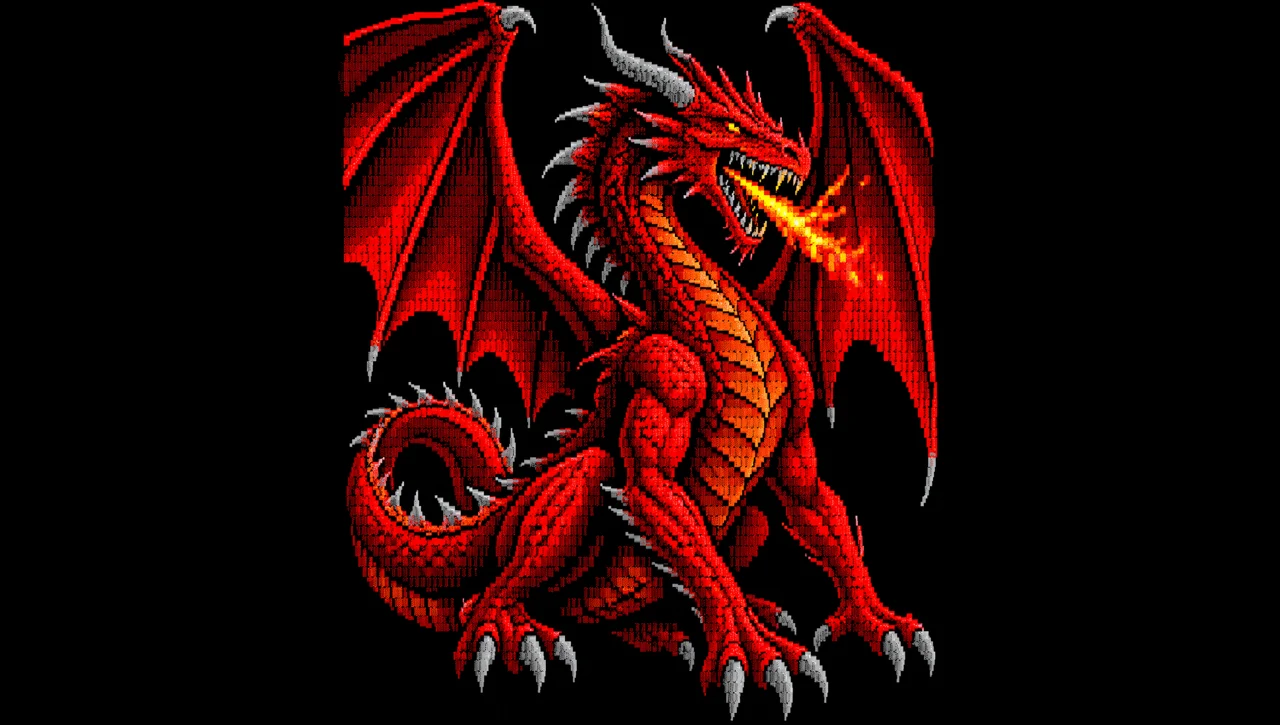
If you dialed into bulletin board systems in the early ’90s, you probably remember Legend of the Red Dragon. LORD was a “door game”: a text RPG you played over a modem, a few turns a day. You hunted monsters in the forest, trained under a series of masters, flirted with the barmaid at the inn, and eventually went after the Red Dragon that was carrying off the town’s children. Then you came back tomorrow, because the game only gave you so many fights per day.
Seth Robinson wrote it in 1989, and at its peak it was reportedly played more than a million times a day across BBSes worldwide. I lost a lot of evenings to it.
On a Saturday night I asked Claude a simple question: is the source code available? By the end of the night I had my own version running on my phone, with pixel art.
▶ Play Ember Wyrm in your browser
Is the original source code available?
No. The original Turbo Pascal source has never been released. Robinson sold LORD to Metropolis Gameport in 1998. The company went quiet years ago, and the developer it later hired has said he cannot release anything without its permission. Robinson himself has spent years trying to buy the rights back so he can open source it.
There are community projects, including a Synchronet JavaScript rewrite and Legend of the Green Dragon, an open source PHP remake. None of them is the original.
I also asked whether the rights might be for sale and what they would be worth. As far as public information goes, they are not listed, the game makes almost no money today, and the obvious buyer is the creator himself. That settled it: we would build our own.
What did we keep, and what did we write from scratch?
Building our own also means it is actually ours. I told Claude this was just for me, not for sale. It still pointed out that LORD’s writing and characters are copyrighted whether anyone pays for them or not. So we kept the mechanics, which is what made the game fun, and wrote everything else new:
- The village of Thornwick instead of the original town, and the Gloamwood for the forest
- Eleven new masters, from Old Hob with his walking stick up to Master Corvin
- 48 original monsters across 12 levels, from Rabid Squirrels to Elder Wyrmlings
- Three classes: Sellsword, Hedge Mage, and Footpad, each with a daily special attack
- The Crooked Lantern inn, with Rowan the barmaid and Maren the bard
- And at the end, the Ember Wyrm
The core loop is the one I remember: 20 forest fights per real-world day, gold and experience, better weapons and armor, one shot per day at your master, and death costing you the gold you carry. Once you kill the dragon, you start over at level 1 with a few permanent bonuses and your name in the Hall of Legends.
How do you balance a game before anyone plays it?
This part surprised me. Before building any screens, Claude wrote the game engine and then a simulator: a bot that plays the way a sensible person would. It fights, heals when it is hurt, buys gear when it can afford it, and trains when it is ready.
The first run showed a real problem. Healing cost so much that the bot ran out of gold around level 7 and got stuck there forever. Claude adjusted the healer’s pricing and the monster damage, then ran it again. Then the bot leveled too fast, so it slowed experience gain. A few rounds later, the bot was killing the dragon in about 17 game days, with a handful of deaths along the way. That is about the “come back tomorrow” pace the original had.
That is the kind of tuning I would normally discover the hard way after a week of play.
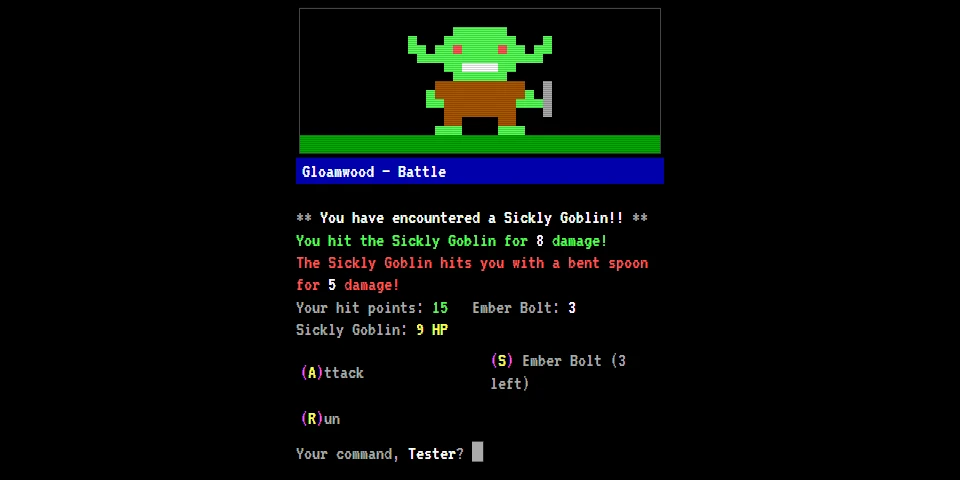
How did the ANSI art get made?
The first version was pure text, styled like a DOS terminal: black screen, the classic 16-color palette, and a pixel font, with every menu option big enough to tap. It played well, but I wanted the art that made BBSes memorable.
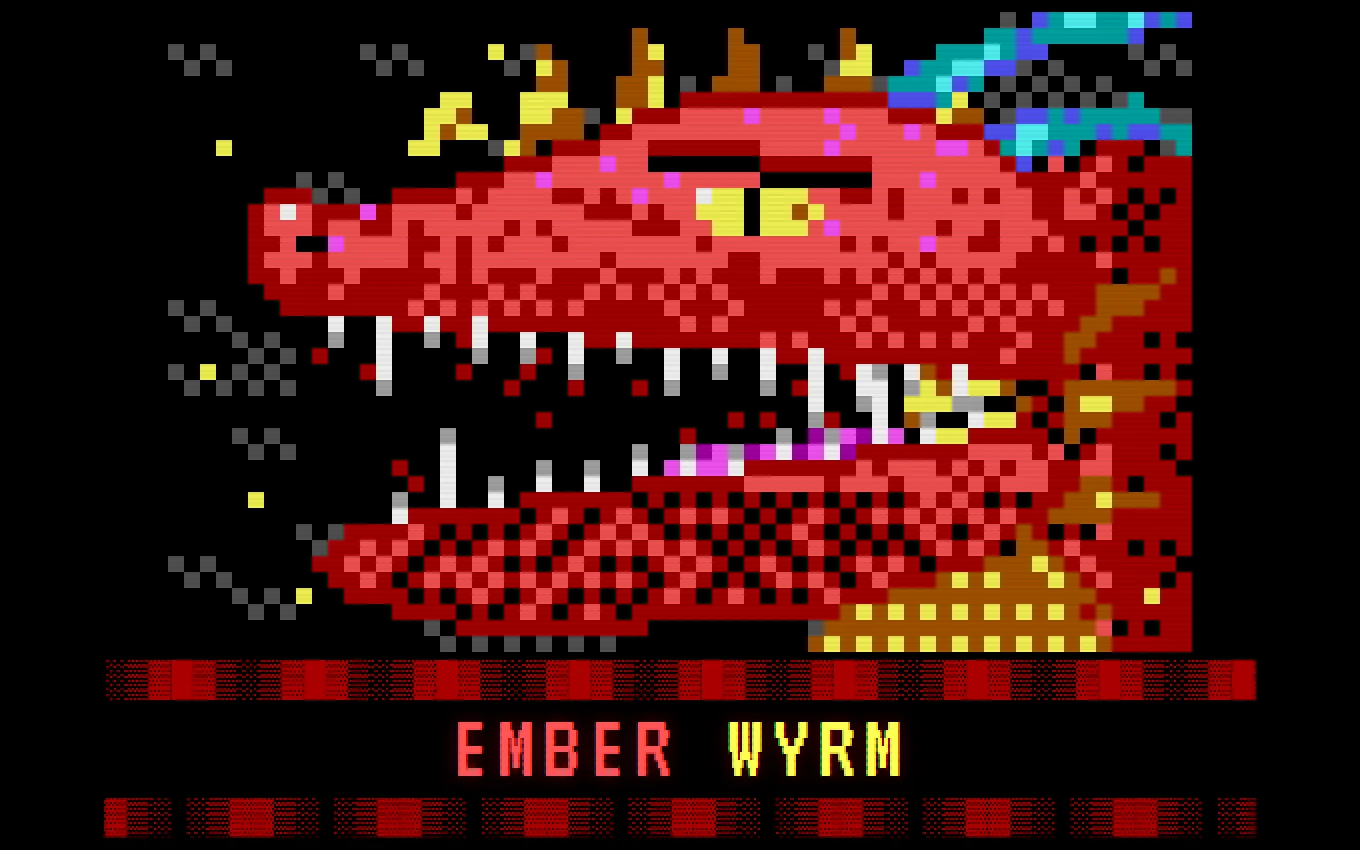
So we added it. Every location got its own picture in the 16-color palette: the village square under the stars, the forest with red eyes glowing between the trees, the smithy’s anvil, the inn with its lantern. There are monster sprites, recolored so all 48 creatures look different. And for the title screen I wanted a red dragon drawn in the style of the old ACiD-era art groups.
I sent Claude a screenshot of a classic ANSI dragon from 16colo.rs as a style reference. It did not copy that piece. It drew an original roaring dragon head in the same spirit, using checkerboard dithering for shading the way ANSI artists faked gradients with ░▒▓ characters: rows of fangs, a glowing slit eye, cyan horns, and fire building in its throat.
What changed after playing it on a phone?
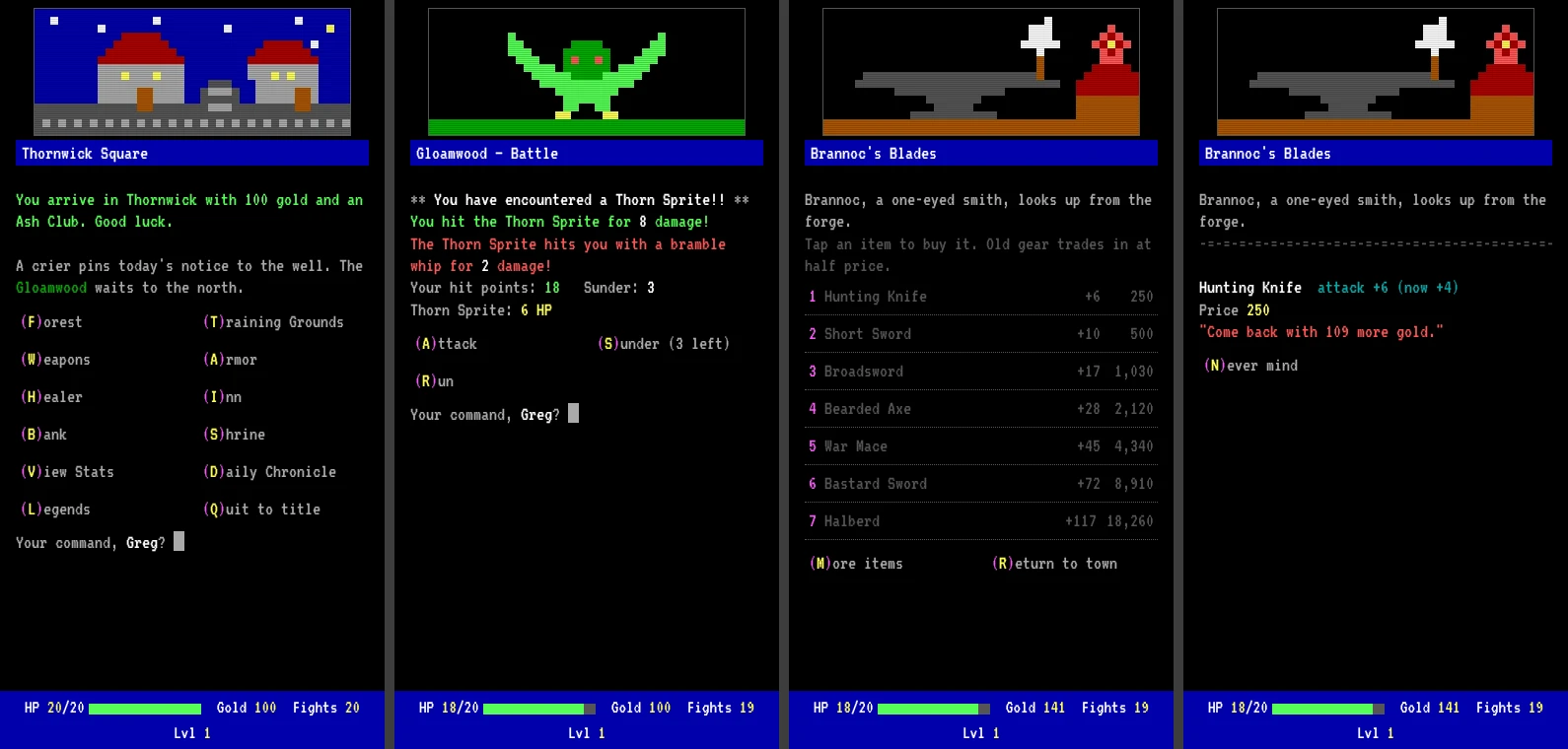
- Tap to buy. Originally you hit “Buy” and typed an item number. Now you tap the item, see the price and trade-in value, and confirm.
- One screen, no scrolling. Everything fits on a phone screen, and there is a graphics toggle if you want pure text.
- Renting a room. I did not want to wait until midnight for more fights, so the inn now rents a room for the night. It costs about two fights’ worth of gold at every level: steep early, pocket change by the late game, which feels right.
- Autosave. Your hero saves in your browser after every move, so you can close the tab and come back to the same hero tomorrow.
What did I take away from it?
I have been building software for a long time, so I know roughly what this would have cost me alone: a few weekends at least, and the art never would have happened. In one evening of conversation I got:
- An answer to a legal and historical question I had wondered about for years
- A balanced game engine, tested by simulation before I played it
- A mobile-friendly interface that takes me straight back to 1993
- Original pixel art I could not have drawn myself
What made it work was the back and forth. I played it, said what felt off, and it changed. That is the same way we work with clients on real business tools: describe the outcome, try what comes back, adjust. The difference is that the loop now runs in minutes instead of weeks. If you want to see more of what that looks like, the build apps with AI showcase collects the other projects, and our AI services page covers how we do it for businesses.
Now if you will excuse me, I have a wyrm to kill. Those masters are not going to beat themselves.
— Greg
Ember Wyrm is a personal project inspired by Legend of the Red Dragon. It is not affiliated with Seth Robinson, Robinson Technologies, or Metropolis Gameport, and it uses no code, text, or art from the original game.