

Inside the AI Business Retreat 2026: What a Room of Owners Actually Built
The gap between companies talking about AI and companies shipping it is no longer about budget or technical staff. It is about whether anyone has written down a specific job and put a name on it.
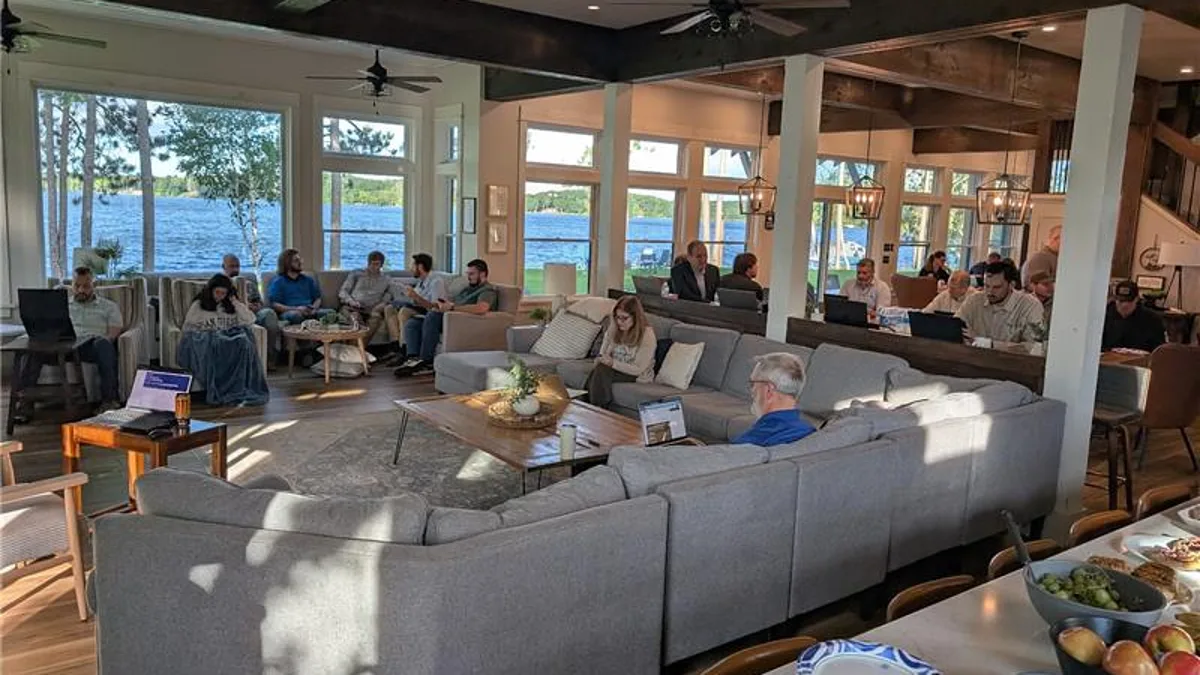
That was the thread running through every session at the AI Business Retreat 2026, held September 14 and 15 at a lakeside lodge in Spooner, Wisconsin. Twenty sessions across three tracks, hosted by Coulee Tech. Nobody watched a keynote about the future of work. People opened laptops and built things, and most of them walked out with something running.
Who was in the room
Rod Holum, CEO and founder of Coulee Tech, ran the event and invited me up to present. Rod is the author of the AI Business Maturity Model, a five-level framework that sorts a company honestly: AI Drifter, Prompted Operator, Agent Builder, Agent Manager, Physical Integrator.
The framework’s value is that it is deflating in the right way. Most owners arrive assuming they are one level higher than they are. A company with ChatGPT licenses and no written process is a Drifter with a subscription, not an Agent Builder. Naming that plainly is what makes the next step obvious.
Aaron Libner, who runs Coulee Tech’s Eau Claire market, and Rene M. Miller, CEO and co-founder of Ener Systems in the greater New Orleans area, both presented as certified AIBMM coaches. Rene and Rod opened the day with a straight-answers buyer’s guide comparing ChatGPT, Claude, and Grok, which is the question every owner asks first and gets the least honest answer to, usually because whoever is answering sells one of them.
Tim Holum, co-founder of Coulee Tech, ran a build session taking real data all the way to a live dashboard. He and I also co-presented a working lunch where we built a daily financial dashboard on the projector in front of the room, which I wrote up separately in the daily business dashboard you check on your phone.
The session that recalibrated the room
Jeremiah Holum presented a CRM he built for cold calling and SDR work, with marketing postcards carrying unique QR codes so every piece of mail is individually attributable back to the lead record. Not a prototype. A working system with a real workflow behind it.
Jer is seventeen. He is Rod’s son.
The thing he built would have been a funded project with a team and a timeline three years ago. The barrier that used to protect incumbents was never really the idea. It was the cost of building it. That barrier is largely gone, and it is not coming back.
If you run a business and your competitive position depends on custom software being expensive, that is now a strategic risk rather than a moat.
What we demonstrated
Alongside my four sessions, we showed two systems Braintek built for our own operation. Both exist because we were paying a vendor for something we could build better and cheaper for ourselves.
XP, our customer experience platform. When a support ticket closes, the customer gets a one-click satisfaction survey. Scores roll into a per-client view so we can see how a specific account feels rather than how the company is doing on average, which is the number that hides the problems. Positive responses route to a Google review request pointed at the correct office location, which matters when you have offices in multiple markets and one of them is starting from zero reviews. On the back end, technicians earn points and recognition for the outcomes they actually produce. It replaced a commercial platform we had been renting for years.
Signatures, a multi-tenant email signature system. Every email leaving the organization gets a correct, current, centrally managed signature stamped on it in transit, so signatures do not depend on employees pasting HTML into Outlook and never updating it. Marketing can run a campaign banner across every outbound message and turn it off the same day. It handles multiple client tenants from one place. It is a replacement for a well-known commercial product in that category, and it took a fraction of what that product costs annually.
The reason we showed these rather than a slide deck is that they are unremarkable software. Neither one is clever. Both are ordinary systems that solved a specific, annoying, expensive problem, which is exactly the point of the AIBMM levels: the companies moving up are not the ones with the best ideas, they are the ones who shipped something boring and kept it running.
The four sessions I ran
Each one is written up in full, with the prompts and the method, so you can run them without attending anything:
- How to hire your first AI employee, the six-line job description that makes the difference between a pilot and a hire
- Turn one photo into a video that speaks in your voice, plus the honest math on renting the tooling versus owning it
- A month of social posts from one job site, because you do not have a content problem, you have a capture problem
- The daily business dashboard you check on your phone, built live with Tim Holum
What actually separated the people who shipped
By the end of the second day, the room had split cleanly, and the split had nothing to do with technical background.
The people who walked out with something working had picked a job small enough to be embarrassing. One email reply. One number on a phone screen. One voice note turned into captions. The people who left with notes instead of output had picked something ambitious, usually a department rather than a task, and spent their build time refining the description of it.
That is the entire lesson, and it survives contact with any industry. The smallest useful thing, written down precisely, with a person’s name attached and a Friday review on the calendar. Everything else is a subscription you are not using.
Where this leaves you
If you are somewhere on the AIBMM ladder and not sure which rung, the honest test is not what tools you have licensed. It is whether you can name one task an AI system currently performs in your business, who checks its output, and what happens when it gets one wrong. If you cannot answer all three, you are a level below where you think.
That is a fixable problem, and the fix is usually an afternoon rather than a project.
We do this work with businesses across Houston and Dallas Fort Worth, and we build the systems we recommend before we recommend them. If you want a second set of eyes on which job to hire first, or you have reached the point where it needs to connect to the systems you actually run on, that is worth a conversation.
Thanks to Coulee Tech for hosting and for the invitation, and to Ener Systems for making the trip north. If you are in Wisconsin, Minnesota, or Iowa, talk to Coulee Tech. If you are around New Orleans, talk to Ener Systems. Both build the things they recommend, which is rarer than it should be.