

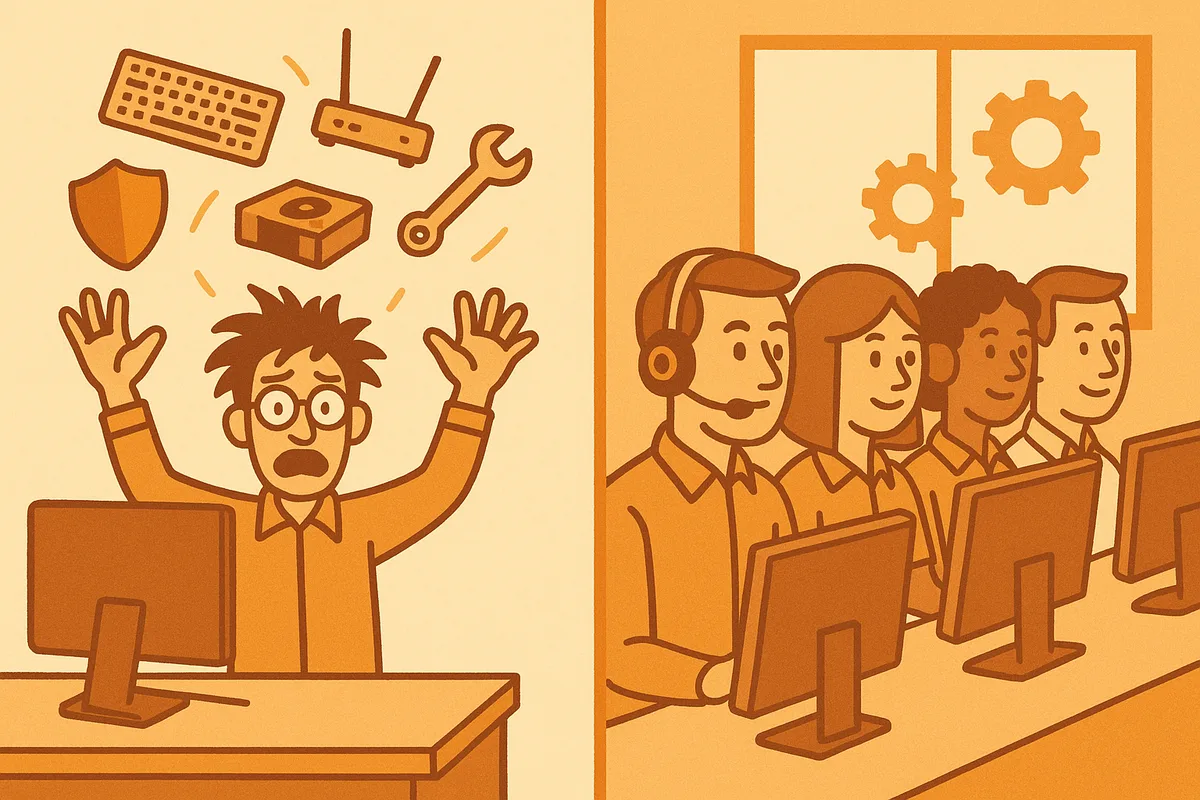
The question sounds binary, but it isn’t. Manufacturers really have three models to choose from: build an internal IT department, outsource everything to a managed IT provider, or run a co-managed setup where an internal person and an MSP split the work. The right answer depends on your headcount, how much a stopped production line costs you per hour, and whether you already have someone good in the seat.
What does internal IT actually cost?
The most common mistake is comparing a salary against an MSP invoice. A salary is the starting point, not the total. A real internal IT budget includes:
- Payroll taxes and benefits on top of base pay
- Recruiting costs, and the risk of a bad hire in a role you can’t easily evaluate
- Ongoing training to keep skills current
- The security, monitoring, and backup tooling that person needs to do the job, licensed separately
- Outside specialists for anything beyond one person’s expertise
- The cost of coverage gaps every time that person is out
Stack all of that against a managed agreement. Braintek’s pricing lands at $150 to $250 per device and $15 to $35 per mailbox each month, with the tooling, monitoring, and security stack already included. For most manufacturers under about 50 employees, the fully loaded internal number loses that comparison, and it’s not close.
How many skills are you really hiring for?
Look at what a single internal IT hire at a mid-size manufacturer is expected to cover: Microsoft 365, networking, firewalls and cybersecurity, servers, cloud platforms, backups, CAD workstations running AutoCAD or SOLIDWORKS, warehouse Wi-Fi, and every vendor relationship in between.
That’s not one job. It’s five or six specialties wearing one badge. The people who genuinely cover all of it are rare and priced accordingly, and the ones you can afford will be strong in two or three areas and improvising in the rest. An MSP flips that math: you get access to a team where someone actually specializes in each layer, without paying for each specialist full time.
What happens when your one IT person is unavailable?
This is the argument that matters most on a production floor. One internal employee means one point of failure. When they’re sick, on vacation, in training, or already buried in a different emergency, your coverage is zero, and outages don’t check the calendar first.
An MSP answers the phone every business day regardless of who’s out. At Braintek, calls reach a live person in about 60 seconds, backed by staff in Houston, Dallas-Fort Worth, and the Philippines, so a single absence never takes your support down with it.
Here’s a fast way to measure your exposure. List the five systems that stop production or shipping when they fail, your ERP, the domain controller, the warehouse wireless, whatever they are for you. For each one, ask: do at least two people know how to support this today? Every “no” is a single point of failure you’re currently accepting.
Already have an IT person? That’s what co-managed is for
If you have a good internal IT employee, the answer usually isn’t to replace them. Co-managed IT keeps that person, and the institutional knowledge they’ve built, while the MSP fills what one person can’t cover: help desk overflow, after-hours and vacation coverage, cybersecurity tooling and monitoring, escalation for hard networking and server problems, and project capacity. Your internal person gets to focus on the systems closest to production instead of drowning in password resets.
We’ve written a full breakdown of how to choose between the outsourced models in fully managed vs. co-managed IT. It’s framed for construction companies, but the decision logic is identical for a plant.
So which model should you pick?
- No internal IT at all: fully managed. One provider, one predictable monthly number, no single point of failure. This is Braintek’s core fit, typically companies around 10 to 50 employees.
- One solid internal IT person: co-managed. Keep them, fill the gaps around them. This is usually the right call for larger manufacturers.
- Downtime is very expensive: whichever model you choose, weight coverage and specialization heavily. The more a stopped line costs per hour, the less acceptable one-person coverage becomes.
If you land on the MSP side of the decision, our guide on how a manufacturing company should choose an IT support provider in Houston or DFW walks through comparing the candidates. Braintek has supported Texas businesses since 2002, including manufacturers in Houston and Dallas-Fort Worth that need remote support most days and someone at the plant when it counts. If you want a no-pressure read on which model fits your operation, the form below is the fastest way to get one.